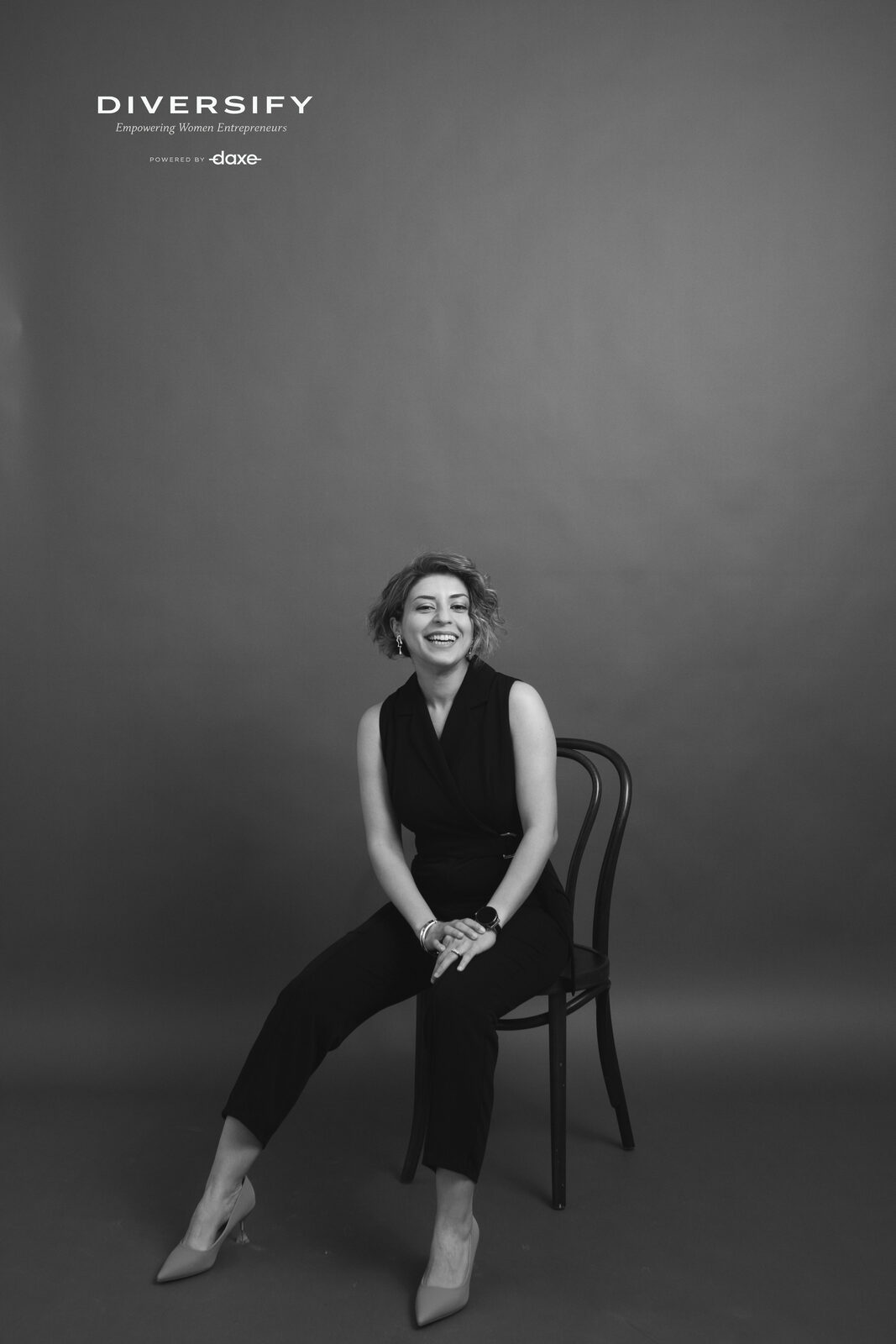
Portrait No. 001
Yasamin Jodat
Co-Founder and CEO
Lagomics
I’m the cofounder and CEO of Lagomics, an early-stage AI x biology company built around a simple belief: some of the most important dimensions of biology remain unseen, and progress has stalled because we don’t know how to measure them. That belief formed during my PhD at Harvard Medical School, where I worked on a bionic nose, trying to give machines access to a sense biology uses effortlessly. It deepened over five years in the Biotech industry, working at the edge of robotics and automation. I watched teams scale experiments through brute force, adding more robots, more assays, more people, yet still relying on trial and error. The cost is staggering. Drugs take billions to develop and fail most of the time because critical molecular interactions are never observed. The same blind spot exists in flavor and fragrance, where human panels stand in for predictive science. Lagomics began as a response to that gap. With my co-founder and team, we are building AI-driven mapping tools to make these hidden interactions measurable in the lab, turning biology from guesswork into something programmable. This is the moment to do it. AI, DNA sequencing, and automation have finally converged, and biology is ready for a new coordinate system.
In her words
“Drugs take billions to develop and fail most of the time because we study molecules one by one, but not how they influence each other. Like sailors before longitude, we navigate with skill, yet without a map. I’m building that map.”
Chapter I
The toughest challenges you've faced as a founder.
I immigrated to the United States from Iran at 23, alone. I left behind my family, knowing I might not see them for years. Five years became seven. In Iran, even at the country’s top engineering university, I was one of the 10% women in the class studying robotics and mechanical engineering. Doing cutting-edge biotech research was not feasible. Leaving was the only way forward. What I gained was a PhD and research experience at a leading lab at Harvard Medical School, and an unrelenting drive to build at the intersection of biology and engineering. Building a deep-tech biotech company as an immigrant woman means proving credibility before it’s granted. I was told the work was too early. Too hard. Too ambitious. We built anyway. With limited resources, we designed a new experimental paradigm, filed foundational IP, secured lab space in the Bay Area, and joined the Activate Berkeley Fellowship. We earned traction the slow way, by building, testing, and showing the work. I learned early how to start from nothing. How to rebuild inside unfamiliar systems. How to turn uncertainty into forward motion. Displacement taught me how to adapt. To learn new languages, new systems, new rules. That same skill now shapes how I build, question, and invent. My mental model is built on an act of creative stubbornness. A refusal to shrink ambition to fit existing structures.
Chapter II
Your vision.
I’m obsessed with what biology hides from us. Much of life is shaped by interactions we can’t see. Because we can’t see them, we guess. We repeat experiments. We accept failure as part of the process. This is why drug development, flavor formulation, and even smell remain unpredictable despite decades of investment. I imagine a world where those interactions are mapped. A world where we don’t just know what molecules exist, but how they behave together across thousands or millions of combinations. Where smell has a coordinate system, like color, and a scent can be composed from underlying dimensions the way red, green, and blue combine to create millions of colors. Where drugs, proteins, and materials are designed in computer models first, the way complex electronics are today, tested with high confidence before they are built. Lagomics is how I’m working toward that future, by creating the missing coordinate in biology. By measuring how biological components behave together at scale, we make previously invisible interactions usable. When those interactions become visible, entirely new things become possible. People can save and share scent the way they share images. Memories carry atmosphere. Films, museums, and games use smell deliberately, composed from a known palette rather than discovered by accident. Medicine shifts upstream, with treatments simulated before they reach patients. Food and materials are designed with foresight, not endless reformulation. This is what changes when biology becomes something we can finally see.
Chapter III
The impact you want to leave behind — for your industry, your community, and the women who come next.
I want my legacy to be that biology made the same transition computing did. Biotech today still resembles mainframe computing in the 70s and 80s: expensive, opaque, and gated by tribal knowledge. My mission is to converge biology with engineering by turning biological interactions into shared maps, data, and models that others can build on. If Lagomics succeeds, technologists, students, and builders from outside traditional pharma won’t need a decade of apprenticeship to contribute, they’ll be able to start from a foundation that is explicit, predicable and usable. Beyond any single company, I want discovery to feel cumulative instead of reset each generation. Beyond any single company, I want programmable biology to compound over time, so progress accelerates instead of restarting with each generation or each new hypothesis.